SW Oregon Ecological Nonprofit Expands Matchmaking Service After Meadow Discovery Raises Existential Questions
SW Oregon Ecological Nonprofit Expands Matchmaking Service After Meadow Discovery Raises Existential Questions
MEDFORD, OR — What began as a routine volunteer matchmaking event has evolved into a multi-agency ecological investigation after two participants in The Understory Initiative’s (TUI) now-infamous SeedySingles program wandered off-trail and uncovered what experts are calling “a highly unusual, and possibly sentient, plant distribution pattern.”
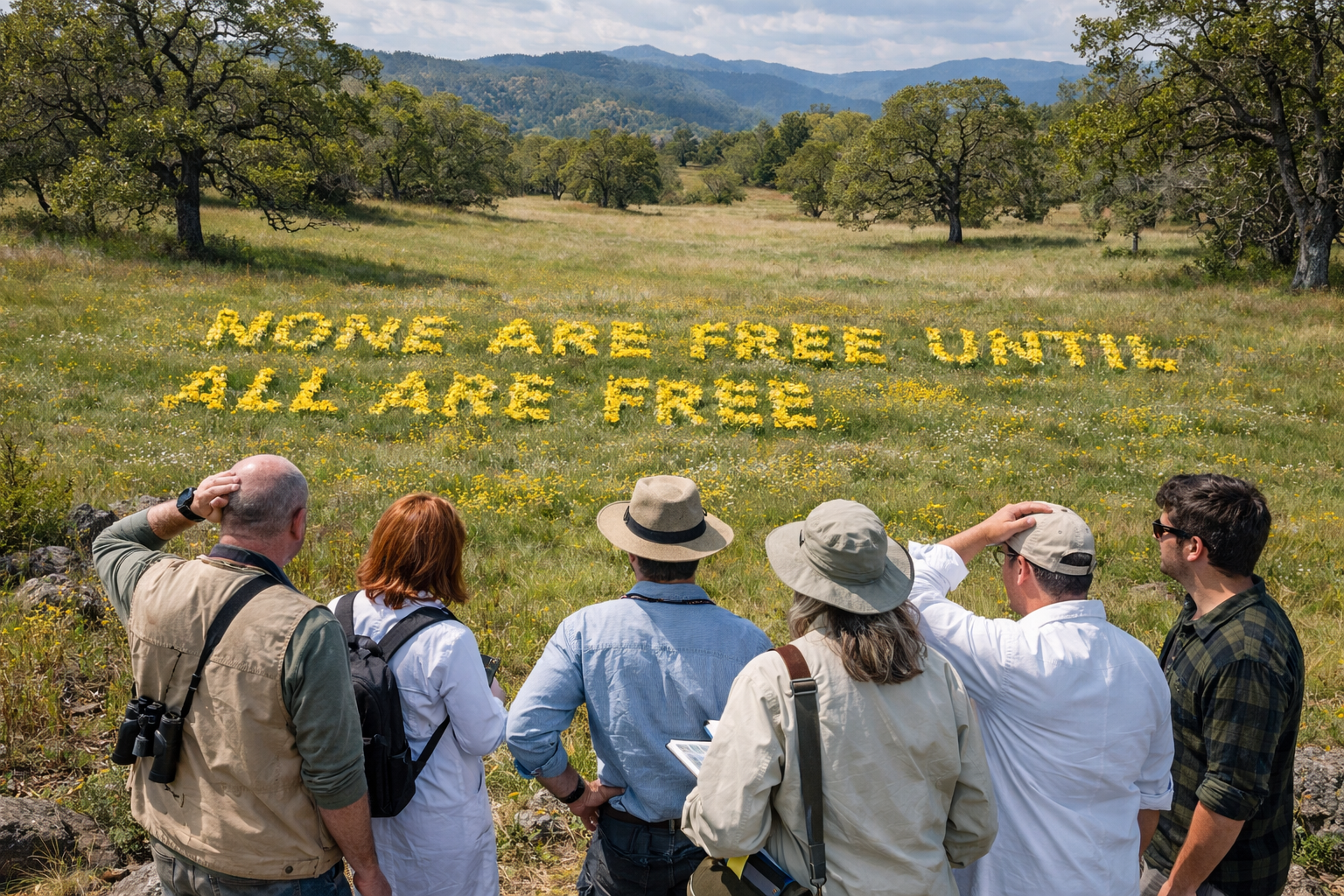
The discovery occurred during a late spring seed collection outing at a meadow within the Rogue River Preserve, managed by the Southern Oregon Land Conservancy. According to participants, what initially appeared to be a standard stand of Lomatium quickly took on a more… intentional quality.
“We thought it was just good habitat heterogeneity at first,” said one participant, who asked to remain anonymous but described the moment as “romantically disorienting.” “But then we noticed the spacing. The clustering. The vibe. It felt… curated.”
The pair promptly reported their findings to TUI staff, including Executive Director Kathryn Prive and Ecologist Vanessa Robertson-Rojas, who confirmed that something, in fact, was “a bit off.”
“At first glance, it looked like a textbook case of microsite variability,” Prive explained. “But the more we stared at it—rotating our field maps, squinting, walking backwards—the less it made sense. Naturally, we initiated a full partnership response.”
What followed was a coordinated, multi-disciplinary effort involving many of TUI’s long-standing collaborators.
The Jackson Soil and Water Conservation District was contacted to determine whether similar patterns had been observed on adjacent private lands. The Natural Resources Conservation Service (NRCS) was brought in to assess whether soil structure, nutrient gradients, or an unusually charismatic soil horizon could explain the phenomenon.
Meanwhile, the Klamath Bird Observatory was consulted to evaluate whether avian seed dispersal—possibly linked to an elaborate mating display—could account for the geometric precision of the arrangement.
“We’ve seen some impressive behavior from corvids,” Jamie Stevens from KBO noted, “but this would represent a significant advancement in both aesthetics and messaging.”
Given the site’s management history, the Southern Oregon Land Conservancy provided detailed records of conservation easements and prior land use, while Lomakatsi Restoration Project was looped in to assess whether past pile burns or cultural burning practices may have influenced plant distribution patterns in unexpected ways.
TUI staff also reached out to botanists with the Bureau of Land Management and the U.S. Forest Service, both of whom confirmed that while Lomatium is known for many remarkable traits, spelling had not previously been documented on public lands.
As the investigation deepened, hypotheses multiplied. Data were collected. Maps were generated. At least one spreadsheet was described as “emotionally significant.”
“And yet,” Robertson-Rojas reflected, “we couldn’t shake the feeling that we were missing something obvious.”
In a final effort to better understand the site, TUI reached out to members of the Inter-Tribal Advisory Committee (ITAC), inviting Tribal partners to visit the meadow and share their perspectives.
After a brief survey of the site—and, notably, a reorientation of the group’s vantage point— elders involved in the Network offered a simple observation:
The plants were spelling out a message.
“None are free until all are free.”
Silence reportedly followed.
“We had been looking at it upside down,” Prive admitted. “For weeks.”
The revelation has prompted both reflection and mild embarrassment across the participating organizations.
“In hindsight, the pattern was quite legible,” said one NRCS soil scientist. “But we were very focused on aggregate distribution.”
The discovery has since been interpreted by some as a powerful reminder of the limitations of siloed expertise and the importance of diverse perspectives in understanding both ecological systems and the landscapes we inhabit.
“It’s a bit like the classic story of the blind men and the elephant,” Robertson-Rojas noted. “Except the elephant is a meadow, and it’s been trying to tell us something the entire time.”
TUI has announced that future SeedySingles events will include a new component encouraging participants to periodically “step back, rotate their assumptions, and consult someone with a different lived experience.”
Whether the original pair found romance remains unclear. However, organizers confirm that they did, at minimum, share a meaningful moment of collective confusion. The next SeedySingles event is scheduled for late spring 2026 and will feature guided seed collection, interdisciplinary dialogue, and optional existential reflection.
In an era defined by increasing complexity, TUI’s latest endeavor serves as both a celebration of partnership-driven science and a gentle reminder: sometimes the answer is already there—just not from where you’re standing.
Disclaimer: TUI is not responsible for misinterpreted plant messages, existential revelations, rotated field maps, bruised egos, or sudden paradigm shifts resulting from participation in SeedySingles events. Standard risks, including ticks, rattlesnake encounters, poison oak, dehydration, and unrequited affection, still apply.
Thanks for reading this spoof from our friends at The Understory Initiative. Happy April Fool’s Day—and remember: when in doubt, try looking at it from another angle.